

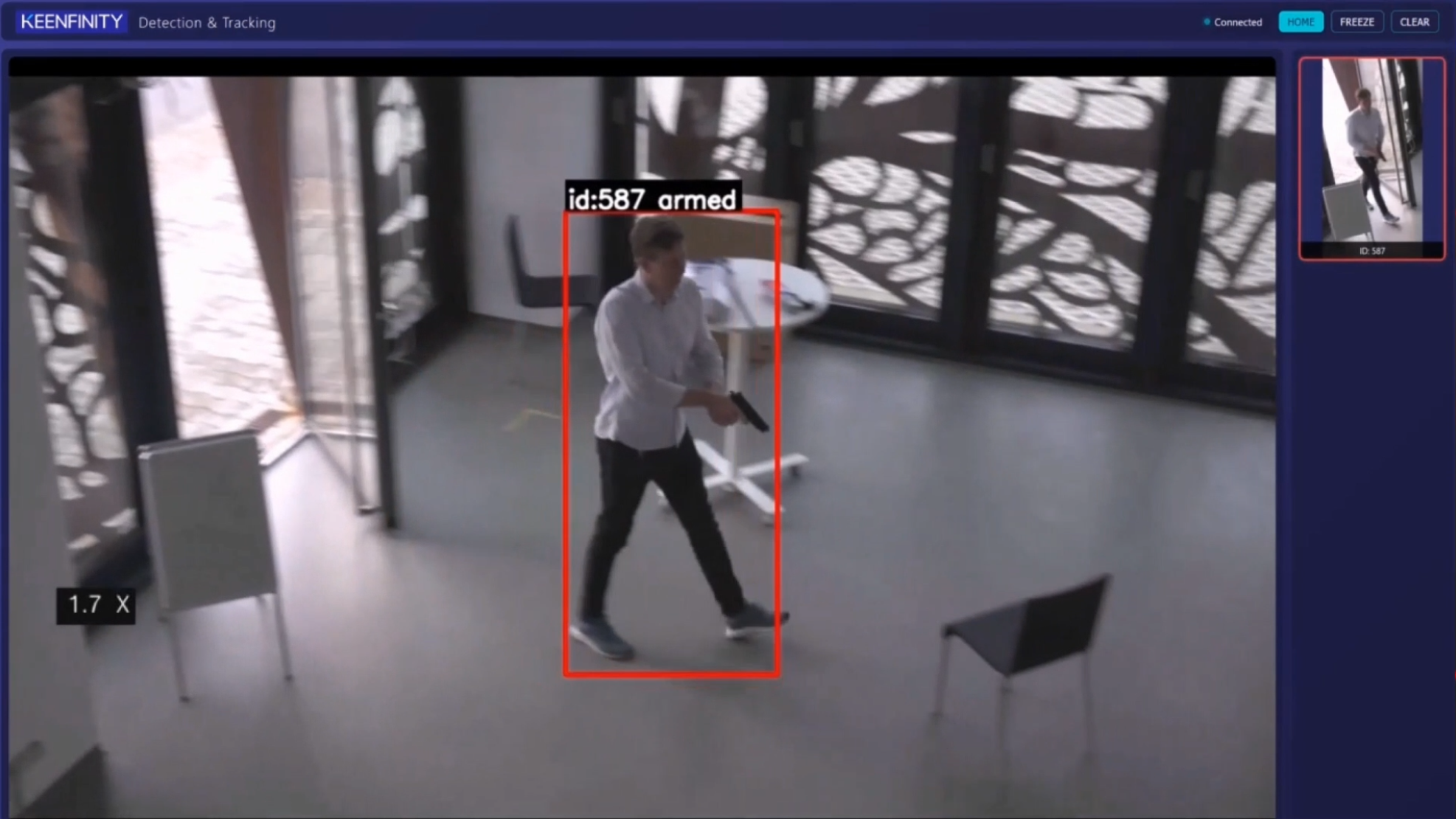
In this Security Technology Forum session, Nils Zerrer and Matt Cirnigliaro walked attendees through how Bosch and KEENFINITY Group are using IVA Pro to move security operations from “record and review later” toward earlier detection, faster verification, and more targeted response. The discussion followed an outside-to-inside narrative: visual gun detection and alarm verification, license plate recognition and watchlists, appearance-based forensic search, and a forward-looking preview of context-aware, generative-AI-assisted real-time alerting.
A consistent theme was operational realism. They repeatedly framed performance as a balance between catch performance (probability of detection) and false positive resistance (avoiding alarm fatigue), with a focus on architectures that remain functional at the edge while selectively using cloud compute when it materially improves accuracy or context.
What they covered and why it matters
Visual gun detection plus AI alarm verification
They positioned visual gun detection as an “invisible layer of safety” that avoids the throughput and psychological impacts of routine screening at entrances, particularly for high-flow environments. Matt added a useful baseline: there are only three ways to know someone has a gun; see it, hear it, or search for it, and each addresses different threat patterns.
The key product update was AI alarm verification (cloud-based review of gun-detection events), explained using an “instant replay” analogy:
-
The camera "makes the call on the field" (edge detection).
-
A short clip is sent to the cloud "for review."
-
In up to roughly 10 seconds, the cloud confirms or overturns the call, enabling downstream actions.
They emphasized the layered value: edge detection continues even if connectivity is lost, while the verification layer is intended to meaningfully reduce false positives when connectivity is available.
One operational data point they cited from a pilot deployment at a school: approximately 92,000 person passes, with about 270 edge “calls” sent for review, resulting in six confirmed events (five test weapons and one false positive that was visually ambiguous). Their message was that the verification layer is designed to approach “human-level” decisioning for what is genuinely hard to judge at a glance.
Practical response guidance they described as an emerging best practice:
-
Lock the door immediately on the edge event with minimal fanfare.
-
Unlock quickly if the verification layer overturns the detection.
-
If confirmed, maintain lock and initiate the broader response.
Pushing detection outward with PTZ coverage
They previewed work pairing gun detection with PTZ (pan-tilt-zoom) cameras to extend detection into wide areas like parking lots, citing that a large share of incidents begin outside the building. The concept: use the PTZ to scan for people, zoom for pixel density, then run detection and auto-tracking without relying on an operator to manually drive the camera.
Matt underscored the underlying constraint: “this stuff is a math problem,” meaning pixel density matters because firearms are small in the image. Their PTZ concept is intended to solve that physics problem at distance.
License plate recognition design plus camera-based watchlists
They moved to vehicle entry and focused on two areas: getting the installation geometry right, and making LPR more operationally useful.
They described a simple Bosch / KEENFINITY design tool that:
-
Accounts for region-specific plate character sizing,
-
Uses mounting height and distance to ensure a workable tilt angle (they referenced a target range of 15 to 30 degrees),
-
Recommends suitable camera options based on the deployment parameters.
The major functional update described was on-camera watchlists (introduced with an upcoming firmware release), supporting up to 16 lists and enabling actions without requiring a round trip to the VMS. They outlined common use cases:
-
“Watch list” alerting for known problem vehicles,
-
“Allow list” logic for employee parking and gate control via relay,
-
Special handling lists for VIPs or emergency vehicles.
They also addressed privacy and legal considerations at a practical level: reading plates is not inherently identifying a person, but risk increases when plate data is cross-referenced to individuals. Their point was that best practices and legal frameworks are still evolving, so customers should be deliberate.
Operational note: they stated lists can be bulk uploaded via CSV, which aligns with how many access control systems can export credential data.
IVA Pro Appearance for faster forensic investigations
Inside the building, they demonstrated appearance-based forensic search in Bosch VMS: searching across multiple cameras using attributes like clothing colors, gender presentation, hair characteristics, and accessories like backpacks, and then jumping through correlated “hits” on the timeline.
Their key value proposition: tasks that once required extensive manual video review can be reduced to minutes by indexing and searching metadata. They also noted ongoing expansion of attributes, including age filtering.
Licensing model: they stated IVA Pro Appearance requires a license and is a perpetual, one-time cost.
They also mentioned that metadata can be consumed by major platforms that support the relevant streams, naming Genetec and Milestone as examples.
IVA Pro Context: generative-AI scene understanding for real-time alerts
Their forward-looking segment described a new offering called IVA Pro Context, intended to provide proactive, real-time alerting by combining:
-
On-camera analytics as an efficient trigger (edge),
-
Generative-AI scene understanding to add context (cloud or private cloud models),
-
Natural language configuration for what constitutes the event of interest.
They explained the difference between “what” and “why”:
-
Traditional edge analytics can detect “a person loitering.”
-
Context aims to interpret why: tying a shoe, vandalism, distress, etc., and route alerts appropriately.
They demonstrated a conceptual workflow using a vandalism example:
-
Edge analytics triggers when a person stays in an area longer than a threshold (example: five seconds),
-
The system sends a frame for contextual verification,
-
Only verified events are promoted into the VMS as a more meaningful incident type (example described: “spray paint vandalism”), reducing operator noise.
They acknowledged cloud constraints for highly secure environments and described two directions:
-
Private cloud deployments for government-type users,
-
A planned edge-based version with reduced capability relative to cloud, with timing discussed as “second half of next year” in their remarks.
Key takeaways security leaders can apply immediately
-
Treat gun detection performance as two separate requirements: high probability of detection and strong false positive resistance to avoid alarm fatigue.
-
Consider “downstream response” early. Their suggested pattern was fast door control first, then escalate only after verification.
-
For LPR, invest in geometry and lensing, not just the feature checkbox. Small angle mistakes can defeat capture quality and speed tolerance.
-
Use watchlists intentionally, with clear governance around who can create lists, how long entries persist, and what actions are automatically triggered.
-
For investigations, appearance search is most valuable when you have multiple cameras and need to reconstruct movement quickly across zones.
-
For real-time contextual alerts, design the edge trigger to be broad enough to catch candidates, then let context reduce noise before the SOC sees it.
Technical documents on video analytics
Looking for technical documentation on our video analytics offerings? Find white papers, application notes, technical notes, and more on a webpage that consolidates this information for easy access. Click here >>

Panel discussion between Nick Caputo, Don Bridges, Craig Oberschlake, and Tom Mechler about campus safety and gun detection >>

Deep-dive conversation between Nick Caputo and Matt Cirnigliaro about campus safety and gun detection >>

Learn more about Nick's evaluation of gun detection systems >>
Contact us for a demonstration and system design assistance >>