

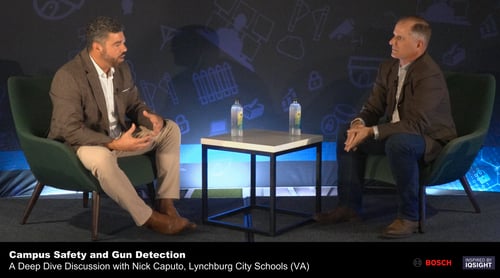
 When Matt Cirnigliaro sat down at Security Technology Forum 2025 with Nick Caputo, the head of safety and security for Lynchburg City Schools in Virginia, the conversation zeroed in on a simple reality. Schools want strong screening at the front door, but they also want reliability when the day gets busy, repetitive, and very human.
Nick described Lynchburg’s approach as a layered system that pairs traditional screening with visual gun detection. Metal detectors are part of the plan, but they are not the whole plan.
“The second one is the Bosch gun detection cameras,” Nick explained. Used together, the goal is to “close the gaps and eliminate any discrepancies or human factor.”
That phrase, human factor, came up again and again, and Nick had a very practical reason for emphasizing it. This conversation was not a sales pitch for a single product. It was an implementation story about reducing gaps, compressing response time, and building a safer environment without changing the soul of a school.
The problem with normalcy bias
Metal detectors work, but they still rely on people to interpret what is happening and act quickly. Over time, repetitive alarms can create what Nick called “normalcy bias,” where a screener begins to assume an alert is harmless.
Nick gave examples that will sound familiar to anyone who has managed a busy entrance: “Oh, it’s just another three ring binder,” or “it’s always the student’s backpack.”
His concern is not that staff are careless. It is that patterns form, and a bad actor can exploit patterns. In Nick’s words, that is “a perfect example for a bad actor to set the school up.”
This is where visual gun detection becomes more than a gadget. In Nick’s model, it acts as a backstop when human attention, confidence, or reaction time is stressed.
“If a gun is presented, the Bosch gun detection cameras react in a millisecond,” he said, triggering downstream actions that do not depend on someone pausing to confirm what they are seeing.
What the deployment actually looks like
Nick walked through the “order of operations” in plain terms. First, the district assessed where student ingress happens, how much volume comes in at key times, and how many detectors were needed to keep students moving into class on time. Then came staffing: how many people are available to run screening, and how consistent can that coverage be day to day?
That staffing reality matters, because as Nick pointed out, screeners are often not full time security professionals. They might be a coach, teacher, or administrator. As he put it, “It’s not their primary duty.”
The visual gun detection layer is designed to keep working even when staffing is thin. Nick’s point was not that people do not care. It is that high consequence events can cause hesitation, disbelief, and cognitive overload.
“When they do [hit a gun], there’s a delay… ‘I can’t believe that this is happening,’” he said, describing the moment when training can evaporate under stress.
So the strategy becomes: use metal detectors as an active screening layer, and use visual gun detection as a frictionless layer that can run continuously in the background.
Testing that tried to break the system
One of the most compelling parts of the discussion was Nick’s emphasis on testing. He did not want a showroom demo. He wanted something closer to real life.
“We tried to break the system. We tried to fool it,” he said. “Every single thing that we did failed. The Bosch gun detection came out on top every single time.”
Matt added a point that most integrators and end users learn the hard way: getting analytics to trigger is not the real challenge. The real challenge is getting them not to trigger when they should not.
Nick described “black on black” testing designed to reduce contrast and make detection harder, and he praised a test where a firearm was only partially presented before the system identified it. The takeaway was not the theatrics. It was the speed and consistency.
An important detail from Nick’s testing is also what did not happen. A holstered firearm on a police officer did not create a detection event, because it was not presented. That matters in a school environment where an armed school resource officer may be present. In Nick’s words, avoiding those false hits helps prevent yet another form of normalcy bias.
Safety that does not feel like a prison
Matt asked a question that every school leader eventually faces: how do you improve protection without making the building feel like a fortress in the worst way?
Nick’s answer was all about communication and the emotional reality of school staff.
“A lot of times people focus on the students… They don’t focus on the staff,” he said. “The staff are human beings too.”
When staff are shown what is being implemented and why, Nick said the reaction is often “smiles” and “a sigh of relief.” He added that transparency about how the system works helps people understand it is not about treating them like suspects.
And then he delivered a line that captures the tightrope schools walk:
“Our goal is that we don’t turn the schools into prisons. We turn ’em into castles.”
In Nick’s framing, metal detectors can feel imposing because students and staff must physically walk through them. But visual gun detection “operates in the background,” and is “always running, always searching, always working.”
That combination is the theme: some safety measures are visible and active, while others are quiet and continuous.
Deterrence is a result, even when nothing is detected
When asked whether the system had caught weapons yet, Nick answered “no,” and everyone agreed that is a good thing. But Nick also said something important for any security program: detection is not only about catching an incident in progress. It is also about changing behavior upstream.
“It has acted as a deterrent,” he said.
He used an analogy about intermittent enforcement, where security is visible and strict at times, then less visibly active at others, while still keeping the underlying capability in place. The logic is that unpredictability makes it harder to plan around security measures. Matt compared it to the “speeding ticket principle,” where enforcement does not need to catch everyone, just enough people to change the risk calculation.
Crucially, Nick emphasized that even when active screening is not obvious, the visual detection layer remains constant.
“The Bosch gun detection system is running all the time regardless,” Matt summarized, and Nick agreed.
Detect, delay, deter, and what happens after an alert
Nick returned to first principles when describing the purpose of security officers and the overall security posture.
“Their primary function in life is to detect, delay, or deter an active shooter,” he said.
But Matt raised the hardest operational issue: downstream response. Many sites invest in detection and then struggle with what to do next.
Nick’s description of their response chain focused on integration and speed. An alert from visual gun detection feeds an emergency notification workflow that can initiate lockdown, notify the right stakeholders, and push information to law enforcement quickly. He described it as a “lightning fast chain of events.”
One operational detail Nick highlighted is situational awareness through mapping. By overlaying camera locations on school maps, an alert becomes more than a video clip. It becomes location context. Nick described camera icons that “blink red” and leave a “breadcrumb trail” showing movement through the building, supporting triage decisions and response coordination.
He also talked about layering gunshot detection into the same concept, so that if a camera view is obstructed at the wrong moment, other sensors can still contribute actionable location data.
Matt’s reaction underscored why this matters: video without context can be hard to interpret quickly, especially in a large campus with similar looking hallways. Mapping makes “where” immediately clear.
Recommendations Nick offered to other campuses
Nick’s advice for schools, higher education, and even corporate campuses stayed grounded in planning, pragmatism, and scalability.
-
Start with budget and long term ownership: Nick emphasized understanding buying power, future constraints, and solutions with longevity, including licensing models that do not create surprise obligations later.
-
Assess what you already have: If metal detectors are in place, think about how to “enhance” them rather than replace everything at once.
-
Think in layers: Nick used the “Swiss cheese” analogy, where every control has holes, but layered controls cover gaps.
-
Prioritize where it matters most: Focus initial deployment where most people enter, then expand.
-
Re-evaluate and refine: Watch for bottlenecks, adjust screening layout, and handle edge cases like late arrivals that enter through the office.
-
Use policies, procedures, and clear communication: Nick referenced accessible threat protocols, shared documentation, and routine drills that prepare people for the “worst day we could possibly ever have.”
-
Be careful about oversharing security details: In Nick’s words, “You don’t put out all of your ingredients to your recipe for success.”
The bigger takeaway
Nick’s core message was that technology should support people, not burden them. When it is deployed thoughtfully, communicated clearly, and integrated into response, it can help staff focus on why they came to school in the first place.
As Nick put it, the goal is fortifying the castle, so students can learn and staff can teach with a little more peace of mind.
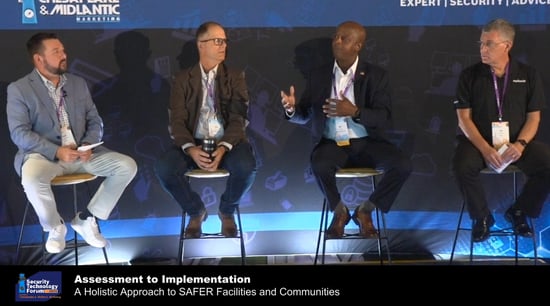
Don't miss the panel discussion between Nick Caputo, Don Bridges, Craig Oberschlake, and Tom Mechler about campus safety and gun detection >>
Learn more about Nick's evaluation of gun detection systems >>
Not sure where to start? Contact us for a FREE campus security site survey >>