
For years, bringing fiber directly to Bosch and IQSIGHT camera locations has been a strong design option for large security systems, campus environments, transportation sites, corrections facilities, utilities, and other demanding applications. Fiber can provide long-distance connectivity, electrical isolation, and strong performance in areas where copper cabling is not practical.
However, one challenge has remained for many system designers and integrators: older fiber modules were limited in speed, while many modern network switches are built around gigabit fiber connections.
In a recent technical discussion, Tom Fontana and Steve Pennington reviewed a new AMG Systems fiber optic module, the AMG260P, designed to solve that problem for Bosch/IQSIGHT AUTODOME camera applications and other compatible camera installations using the universal power supply cabinet.
Legacy Network Connectivity Challenges
The issue starts with the older Bosch fiber module commonly referenced as the VG4-SFP-CKT. That module was useful, but it was limited to 10/100 connectivity. For many legacy installations, that was acceptable. But as network infrastructure evolved, most fiber switches moved to gigabit ports. Many of those switches could not easily be stepped down to 10/100 fiber speeds. That created a practical field problem.
If the camera-side fiber module only supported 10/100, but the network switch side expected a gigabit fiber connection, the system often required an additional media converter. That meant more equipment, more space, more power considerations, and another potential point of failure.
Reduced Field Equipment
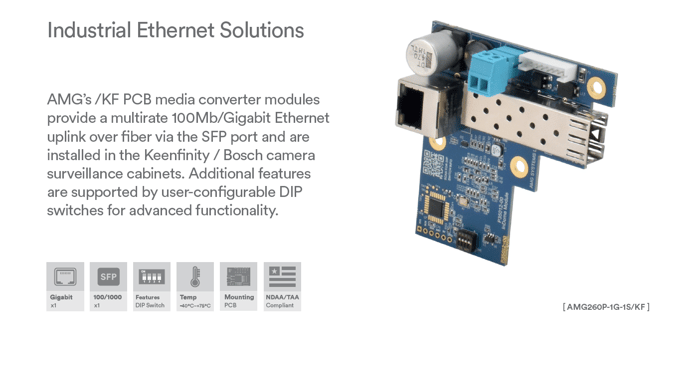
The new AMG module addresses that issue by supporting 10/100/1000 connectivity from a single device. In practical terms, that means the module can support 10 Mbps, 100 Mbps, or 1 gigabit network connections depending on the application and connected equipment.
That is especially important as the older Bosch/IQSIGHT fiber module moves toward end of life with limited remaining availability. For customers maintaining existing VG4-style installations, upgrading camera locations, or converting compatible fixed cameras to fiber, the new AMG module provides a path forward.
No Need to Replace the Mounting Configuration
One major benefit is that the module can help preserve the integrity of an existing installation. In many camera upgrade projects, especially where an older AUTODOME or PTZ camera is being replaced, the existing universal power supply box may already be mounted on a pole, wall, building corner, parapet, or other difficult-to-reach location. Reusing that location and cabinet can simplify the upgrade.
This becomes especially valuable with Bosch/IQSIGHT Gen6 AUTODOME camera applications that require a one-gigabit connection. Previously, some upgrade paths required changes to the mount or the use of other hardware arrangements to support the needed network connection. With this AMG module, designers and installers have another option: place the fiber interface inside the universal power supply cabinet and maintain the existing installation approach.
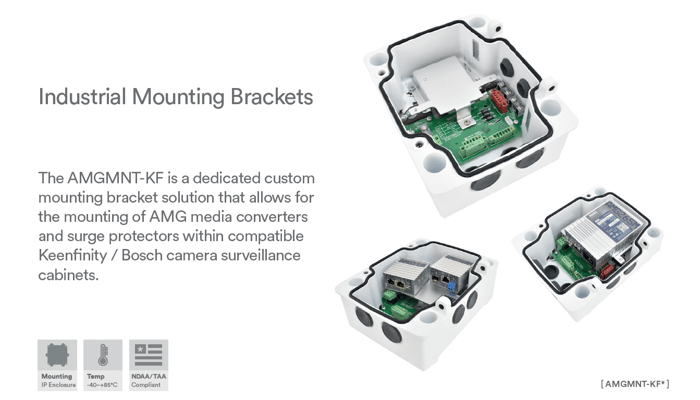
The module is designed to install inside the Bosch/IQSIGHT-style universal power supply box. In the discussion, Tom and Steve reviewed both 110V and 24V power supply cabinet configurations. The 110V version includes the 110V-to-24V step-down transformer. The 24V version has a similar internal layout but does not include that transformer. In that version, a jumper or dropper cable is used to make the 24V-to-24V connection.
The AMG module includes the needed mounting components, including the standoff bracket and screws required to secure the board in place. It also includes the jumper needed for the keyed connection between the module and the power supply board. These keyed connections help ensure the board is installed properly.
SFP Flexibility
From a design standpoint, one of the most important details is that this is an SFP-based module. That means the designer or installer still needs to choose the correct SFP for the application.
That decision depends on the fiber infrastructure and network design. The application may require single-mode fiber or multimode fiber. It may use one fiber or two fibers. The connector type may vary, such as LC or SC. The SFP selection must match the optical path, fiber type, connector type, and switch-side requirements.
AMG Systems offers a broad portfolio of SFPs, which can help simplify that selection process. However, Steve also emphasized an important caution: some switch manufacturers use proprietary or software-keyed SFPs. In those cases, a standard SFP may not be accepted by the switch. If the AMG module is being connected directly back to a fiber switch, the system designer should verify SFP compatibility with the switch manufacturer.
This is an important point for consultants, integrators, and end users. The camera-side module may be flexible, but the switch-side SFP rules still matter. On some networks, a manufacturer-specific SFP may be required.
Remote Device Reset
The module also provides another valuable feature: remote reset capability.
That may sound simple, but it can make a major difference in the field. Many camera power supply boxes are mounted high on poles, on the corners of buildings, above roadways, on parapets, or in other difficult access locations. If a camera or connected device locks up, a technician may otherwise need to roll a truck, unload ladders, or schedule a lift just to cycle power.
With remote reset capability, the device can be power-cycled without physically accessing the box. That gives the integrator or system owner a practical troubleshooting option before dispatching personnel to a difficult or expensive location.
For large security systems, that can reduce service time, improve uptime, and avoid unnecessary field labor.
Multiple Camera Applications
The new AMG fiber module is also flexible from an installation standpoint. It can support AUTODOME applications as well as compatible fixed camera installations, including bullet or dome cameras, when used with the appropriate universal power supply cabinet. The cabinet itself can support a variety of mounting approaches, including wall mount, pole mount, and corner mount configurations.
For security professionals designing or maintaining fiber-connected Bosch/IQSIGHT camera systems, this new module solves several real-world problems at once.
It replaces a limited 10/100 fiber option with a 10/100/1000-capable solution. It helps reduce the need for external media converters. It supports modern gigabit network infrastructure. It provides a path forward as older modules reach end of life. It allows existing universal power supply cabinet locations to remain in service. And it adds remote reset capability to make service and troubleshooting more practical.
System Design Assistance
For technical applications where fiber-to-the-camera is required, this is not just a small accessory. It is a useful infrastructure component that can simplify camera upgrades, reduce points of failure, and help extend the life of well-designed field installations. Our team is here to help design your solution with optimal efficiency - contact us at support@midches.com
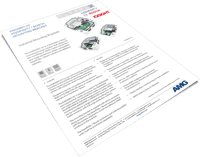
AMG260P Fiber Optic Module Data Sheet
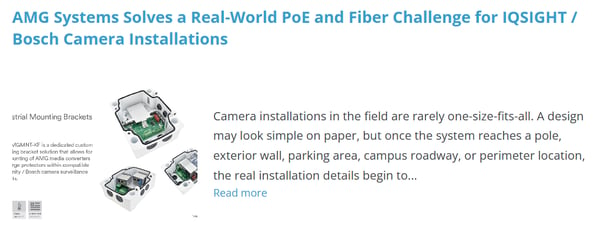
AMGMNT-KF Mounting Bracket Data Sheet
More uses for the AMG bracket
FAQs
What problem does the new AMG fiber module solve?
The new AMG260P fiber module solves a common compatibility issue between older 10/100 camera-side fiber modules and modern gigabit fiber switches. By supporting 10/100/1000 connectivity, it can help eliminate the need for an additional media converter in many Bosch/IQSIGHT AUTODOME camera applications.
Why was the older VG4-SFP-CKT-style module limiting?
The older module was limited to 10/100 network speeds. Many modern fiber switches are designed for gigabit connections and may not easily step down to 10/100 fiber speeds. This often forced integrators to add a media converter between the camera-side fiber connection and the network switch.
Why is 10/100/1000 support important for camera upgrades?
10/100/1000 support gives the system more flexibility. It allows the fiber module to work across different network speeds, including gigabit connections required by newer camera platforms such as Bosch/IQSIGHT Gen6 AUTODOME applications.
Can this module help with existing camera locations?
Yes. One of the major benefits is that the module can be installed inside the universal power supply cabinet. That can allow integrators to preserve an existing camera location, cabinet, and mounting approach during an upgrade.
Does the module include the SFP?
The module provides the SFP socket, but the correct SFP still needs to be selected for the specific application. The designer or installer must consider fiber type, connector type, number of fibers, distance, and switch compatibility.
What should designers check before selecting an SFP?
Designers should confirm whether the system uses single-mode or multimode fiber, one or two fibers, LC or SC connectors, and whether the network switch accepts standard SFPs or requires manufacturer-specific keyed SFPs.
What is remote reset capability?
Remote reset allows the connected camera or device to be power-cycled without physically accessing the power supply box. This is useful when cameras are mounted high on poles, building corners, parapets, or other difficult locations.
Why does remote reset matter?
Remote reset can reduce unnecessary service calls, ladder use, lift rentals, and technician time. It gives the support team a practical first troubleshooting step when a camera or connected device becomes unresponsive.