
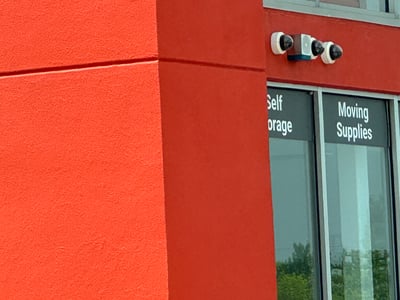
 When a facility needs to monitor several directions from the same exterior location, one common approach is to mount multiple fixed cameras side by side. The image shown is a good example: three separate cameras are installed in a tight cluster on the outside of a building, each likely aimed at a different field of view.
From a security standpoint, this approach can make sense. Each camera can be aimed independently, each view can be recorded continuously, and each scene can be optimized for a specific purpose.
But from a design, installation, maintenance, and aesthetics standpoint, it also raises an important question:
Could the same security objective be achieved with a cleaner and more efficient camera design?
For many facilities, especially retail centers, schools, campuses, transportation sites, commercial buildings, and public-facing properties, the answer may be yes. Depending on the application, alternatives such as an IQSIGHT AUTODOME PTZ, a fish-eye 360-degree panoramic camera, or a FLEXIDOME dual 7100i IR multi-imager camera may provide a better balance of coverage, cost, appearance, and performance.
The key is understanding what each option does well and where each one has limitations.
Key Takeaways
-
Three fixed cameras provide strong continuous coverage but require more hardware, cabling, switch ports, licenses, and maintenance.
-
A PTZ camera offers zoom and active operator control, but it only records the direction it is looking at in that moment.
-
A panoramic camera provides a wide overview from one device, but it may not deliver enough detail at longer distances.
-
A dual or multi-imager camera can provide multiple aimed views from one cleaner housing, reducing installation complexity and visual clutter.
-
The best camera choice should be based on the site’s risk, required detail, viewing angles, operator workflow, and evidence requirements.
Option 1: Three Fixed IQSIGHT 8100i (or similar) Cameras
.png?width=400&height=200&name=8100i%20(1).png) The most obvious advantage of using three fixed cameras is that each view is captured continuously. If one camera is pointed left, one is pointed right, and one is pointed straight ahead, the system is not dependent on a moving camera to be looking in the right direction at the right moment as an incident occurs. That is a major benefit for evidence.
The most obvious advantage of using three fixed cameras is that each view is captured continuously. If one camera is pointed left, one is pointed right, and one is pointed straight ahead, the system is not dependent on a moving camera to be looking in the right direction at the right moment as an incident occurs. That is a major benefit for evidence.
Fixed cameras are also easier to design around specific security goals. One camera can be aimed at a doorway. Another can cover a walkway. A third can monitor a parking area, loading zone, or drive lane. Each camera can be adjusted for the required field of view, pixel density, lighting condition, and analytics rule.
With IQSIGHT fixed 8100i models, this approach can also bring strong imaging and analytics capabilities. The FLEXIDOME 8100i IR X series includes remote pan, tilt, roll, and zoom (OTRZ) setup, Starlight X technology, intelligent IR illumination, HDR X, and IVA Pro analytics depending on the specific model and configuration.
The downside is that the installation can become bulky. Three cameras usually mean three devices, three mounts, multiple penetrations or raceway considerations, more cabling, more switch ports, more licenses, and more points of maintenance. It can also look cluttered on the side of a building, especially in a public-facing commercial environment.
In the image, the three-camera cluster is functionally understandable, but visually noticeable. For some properties, that may not matter. For others, especially storefronts, campuses, hospitality, or mixed-use spaces, the appearance of the security system can be part of the overall design concern.
Pros of three fixed cameras
Three fixed cameras provide continuous recording of multiple directions, strong forensic reliability, independent aiming, and predictable analytics coverage. This is often the most dependable option when every view matters all the time.
Cons of three fixed cameras
The tradeoff is more hardware, more installation labor, more infrastructure, more maintenance, and a less refined appearance on the building.
Option 2: AUTODOME PTZ Camera
 An AUTODOME PTZ camera solves a different problem. Instead of using three cameras to watch three fixed scenes, a PTZ can pan, tilt, and zoom across a wide area on a set schedule or tour. This can be extremely useful when a security operator needs to investigate live activity, zoom in on a subject, or follow movement across a larger scene in real time.
IQSIGHT’s AUTODOME 7100i IR portfolio includes 1080p and 4K ultra-HD models, 12x to 40x optical zoom, optional IR, starlight technology, and IVA Pro analytics depending on the model.
The biggest advantage of the PTZ is detail on demand. A fixed camera may show what happened in its assigned view, but a PTZ can zoom in to gather more detail when an operator or automated rule directs it to the right location based on manual operation or even in reaction to an analytics alert from a separate fixed camera.
However, a PTZ should not be viewed as a direct replacement for three fixed cameras in every case.
The reason is simple: a PTZ can only look in one direction at a time. If the camera is zoomed in on one subject, it may not be recording something important happening outside that view. Presets, tours, and analytics can help, but they do not fully eliminate that limitation.
A PTZ is often strongest when used as a companion to fixed cameras. The fixed cameras provide the constant recording and analytics of the scene. The PTZ provides active investigation and zoomed-in response.
Pros of an AUTODOME PTZ
A PTZ provides flexible wide-area monitoring, optical zoom, operator control, and strong live-response capability.
Cons of an AUTODOME PTZ
It does not continuously record multiple directions at the same time. If the security objective requires constant evidence from every angle, a PTZ by itself may not be enough.
Option 3: Panoramic Camera
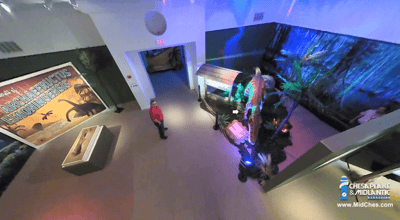 A 360-degree panoramic camera offers a cleaner way to capture broad situational awareness from a single device. Instead of mounting three cameras side by side, a panoramic camera can provide a wide overview of a scene from one housing.
IQSIGHT FLEXIDOME panoramic 7100i provides 180-degree or 360-degree coverage for applications that need wide-angle area coverage and fewer blind spots.
This can be a strong fit for areas where the main goal is to understand movement across a broad scene. A panoramic camera can help operators see the bigger picture, including how people, vehicles, or activity move through an area.
The main limitation is detail at distance. Because the camera is spreading its resolution across a very wide field of view, the image may not provide the same pixel density on a distant doorway, vehicle, face, or object that a dedicated fixed camera would provide. Dewarping can make the image easier to view, but it cannot create detail that was not captured by the sensor.
For the type of exterior wall shown in the image, a panoramic camera may be useful if the goal is broad awareness of the storefront or surrounding area. But if the goal is detailed identification at specific points, such as doors, drive lanes, or payment areas, panoramic coverage may not be the best stand-alone choice.
Pros of a panoramic camera
A panoramic camera can reduce device count, improve visual appearance, simplify installation, and provide broad scene awareness from one location.
Cons of a panoramic camera
It may not provide enough detail at distance, especially when compared with individual fixed cameras aimed at specific targets.
Option 4: FLEXIDOME Dual/Quad 7100i IR Multi-Imager Camera
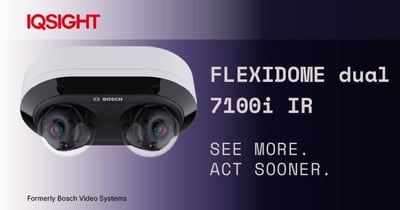 The FLEXIDOME dual 7100i IR may be the most direct alternative to the type of installation shown in the image.
Instead of mounting multiple individual cameras next to each other, a dual- or quad-imager camera places two or four adjustable camera views inside one housing. IQSIGHT's version uses two or four varifocal lenses in one camera housing to provide dual- or quad-directional views from a single mounting point. It is positioned for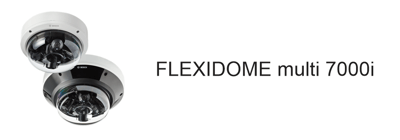 applications such as corners, intersections, and wide areas.
The camera can provide two or four imagers with high resolution and frame rate in one camera housing on a single IP address, along with orientation-based split IR, HDR X, and IVA Pro analytics.
This makes it a strong option when the goal is to reduce camera count without giving up targeted views. For example, instead of installing two fixed cameras to cover two directions, a dual-imager camera may provide both views from one device.
In a location like the one shown in the image, this could create a cleaner-looking installation. It may also reduce cabling, mounting hardware, switch port usage, and installation time.
However, it may not replace all three fixed cameras in every scenario. If the site truly needs three independently aimed, continuously recorded views, a four-imager camera may be the answer.
Pros of a FLEXIDOME dual 7100i IR
It offers multiple fixed views from one housing, a cleaner appearance, reduced infrastructure, fewer devices to mount, and a strong balance between coverage and efficiency.
Cons of a FLEXIDOME dual 7100i IR
Because multiple views depend on one device, a single device failure can affect more than one camera view.
Design Comparison
| Option | Best Strength | Main Limitation | Best Use Case |
|---|---|---|---|
| Three fixed 8100i cameras | Continuous coverage of multiple specific views | More visible hardware and infrastructure | Critical areas where every view must be recorded at all times |
| AUTODOME PTZ | Optical zoom and active operator control | Only looks in one direction at a time | Large areas where live investigation and tracking matter |
| Panoramic camera | Broad overview from one device | Less detail at distance | General situational awareness across a wide scene |
| FLEXIDOME dual/quad 7100i IR | Multiple aimed views from one clean housing | Many views in one housing | Building corners, storefronts, intersections, and wide exterior areas |
The Real Design Question
The image is a useful reminder that camera design is not just about whether a location is covered. It is about how well it is covered, how cleanly it is installed, and whether the system captures the right level of detail for the risk.
Three fixed cameras may be the best choice when evidence is the priority and all views must be recorded continuously. A PTZ may be better when live operators need to zoom in and respond to activity. A panoramic camera may be the right answer when the goal is broad awareness from a single device. A dual or multi-imager camera may offer the best balance when the site needs multiple fixed views but wants a cleaner and more efficient installation.
In many cases, the best design may be a hybrid. For example, a facility could use a dual-imager camera for two primary views and add one fixed camera for a critical doorway. Or it could use fixed cameras for evidence and a PTZ for active response. Or it could use a panoramic camera for overview and fixed cameras for identification points.
The right answer depends on the security objective.
The three-camera installation shown in the image is a practical solution, but it is not the only solution. It provides strong continuous coverage, but it also adds hardware, visual clutter, infrastructure, and maintenance points.
Modern IQSIGHT camera options give system designers more flexibility. Fixed 8100i cameras can deliver dedicated evidence-quality views. AUTODOME PTZ cameras can provide zoom and active response. Panoramic cameras can simplify wide-area awareness. FLEXIDOME dual 7100i IR cameras can reduce device count while still supporting multiple aimed views from one housing.
For security professionals, the goal should not be to choose the camera with the widest view or the most features. The goal should be to choose the camera architecture that best supports the site’s risk, viewing requirements, evidence needs, and operational workflow.
A clean installation is valuable. But a clean installation that also captures the right information at the right time is even better.
Contact our team for system design assistance
Need help deciding which camera architecture fits your project? Our team can help security professionals, integrators, consultants, and facility teams compare coverage options, review site conditions, and evaluate the right IQSIGHT camera design for the application.

IP Video Product Guide >>
.png?width=200&height=168&name=image009%20(5).png)
What is the benefit of using three fixed security cameras in one location?
The main benefit is continuous coverage of multiple views. Each camera can be aimed at a specific area, such as a doorway, parking lot, sidewalk, or drive lane. Unlike a PTZ camera, fixed cameras do not need to move, so each view is recorded all the time.
What is the downside of installing three fixed cameras side by side?
The downside is added infrastructure and visual clutter. Three cameras usually require more mounting hardware, cabling, switch ports, VMS licenses, configuration time, and maintenance. On a public-facing building, the installation may also look bulky or less refined.
Can a PTZ camera replace multiple fixed cameras?
A PTZ camera can replace some functions of multiple fixed cameras, but not always. A PTZ can pan, tilt, and zoom across a large area, but it can only look in one direction at a time. If continuous recording of multiple views is required, fixed cameras are usually still needed.
When is a PTZ camera the best choice?
A PTZ camera is best when live operators need to investigate activity, zoom in on subjects, follow movement, or respond to incidents in real time. PTZ cameras are often useful in parking lots, campuses, transportation facilities, public spaces, and perimeter applications.
What is the main limitation of a PTZ camera?
The main limitation is that a PTZ camera cannot watch every direction at once. If it is zoomed in on one area, it may miss activity happening elsewhere. For this reason, PTZ cameras are often used with fixed cameras rather than instead of them.
What is a panoramic security camera?
A panoramic security camera is designed to capture a very wide field of view from one device. Depending on the model and mounting location, it may provide 180-degree or 360-degree scene coverage.
When should a panoramic camera be used?
A panoramic camera is useful when the goal is broad situational awareness. It can help security teams understand activity across an open area, lobby, hallway, intersection, storefront, or common space from a single camera location.
What is the downside of a panoramic camera?
The main downside is reduced detail at distance. Because the camera spreads its resolution across a wide view, it may not provide the same level of detail as a fixed camera aimed at a specific target area.
What is a multi-imager security camera?
A multi-imager security camera uses more than one lens or sensor inside a single camera housing. This allows one device to capture multiple views, often in different directions, from one mounting location.
What is the benefit of a dual-imager or multi-imager camera?
The main benefit is efficiency. A dual-imager or multi-imager camera can reduce the number of separate cameras needed while still providing multiple fixed views. This can lower installation time, reduce cabling, simplify mounting, and create a cleaner appearance.
Can a multi-imager camera replace three fixed cameras?
It depends on the required views. A dual-imager camera may replace two fixed cameras, but it may not fully replace three separate cameras if the site needs three independent, continuously recorded views. In some designs, a multi-imager camera may be paired with one additional fixed camera.
Which camera option is best for exterior building corners?
For exterior building corners, a dual-imager or multi-imager camera can be a strong option because it can cover two directions from one housing. However, if each direction requires high detail or independent redundancy, separate fixed cameras may still be the better choice.
Which camera option is best for evidence?
Fixed cameras are usually best for evidence when specific views must be recorded continuously. They provide a stable, predictable view and are less likely to miss an incident because they are not moving or looking somewhere else.
Which camera option is best for live monitoring?
A PTZ camera is often best for live monitoring because it allows operators to pan, tilt, zoom, and follow activity. However, it is usually most effective when supported by fixed or panoramic cameras that provide constant overview coverage.
Which camera option has the cleanest appearance?
A panoramic or dual/multi-imager camera typically provides the cleanest appearance because it reduces the number of visible devices on the building. This can be important for storefronts, commercial buildings, schools, campuses, and public-facing facilities.
How should a facility choose between fixed, PTZ, panoramic, and multi-imager cameras?
A facility should start by defining the security objective. If every view must be recorded continuously, fixed cameras may be best. If operators need zoom and active response, a PTZ may be needed. If broad awareness matters most, a panoramic camera may work well. If multiple views are needed from one clean installation point, a multi-imager camera may be the best balance.
Are three fixed cameras better than one PTZ camera?
Three fixed cameras are better when multiple views need to be recorded continuously. A PTZ camera is better when operators need to zoom in, move the view, and investigate activity in real time.
Is a panoramic camera better than multiple cameras?
A panoramic camera can be better for broad awareness and cleaner installation, but multiple fixed cameras are often better when the site needs more detail in specific directions.
Do multi-imager cameras reduce installation cost?
Multi-imager cameras can reduce installation cost by lowering the number of separate devices, mounts, cable runs, switch ports, and licenses needed. The actual savings depend on the site design and system requirements.
What is the best camera for a building exterior?
The best camera for a building exterior depends on the view. Fixed cameras are strong for specific target areas. PTZ cameras are useful for active monitoring. Panoramic cameras provide wide overview coverage. Multi-imager cameras are useful when multiple directions need to be covered from one mounting location.
Why not just use one wide-angle camera?
One wide-angle camera may show the whole scene, but it may not provide enough detail at distance. Security design often requires balancing field of view with pixel density, identification needs, and evidence quality.