

In this Security Technology Forum 2025 session, Mike Brewer (Marketing Manager, North America for BVMS and related solutions) and Maciej Wróbel (Global Product Manager for BVMS) focused on a practical operator problem: investigations are often slowed down not by a lack of video, but by the time it takes to find the right moments across many cameras. Their theme was straightforward: use metadata more effectively, so operators spend less time hunting and more time acting.
BVMS is a modular, resilient security system that consolidates data for operators, scales from small to enterprise deployments, and can be upgraded across editions without changing the operator experience.
Below is a summary of the capabilities they discussed and demonstrated, what is already in the field with BVMS 13, and what they previewed.
 Visualizing IVA Objects Directly on Maps in BVMS 13
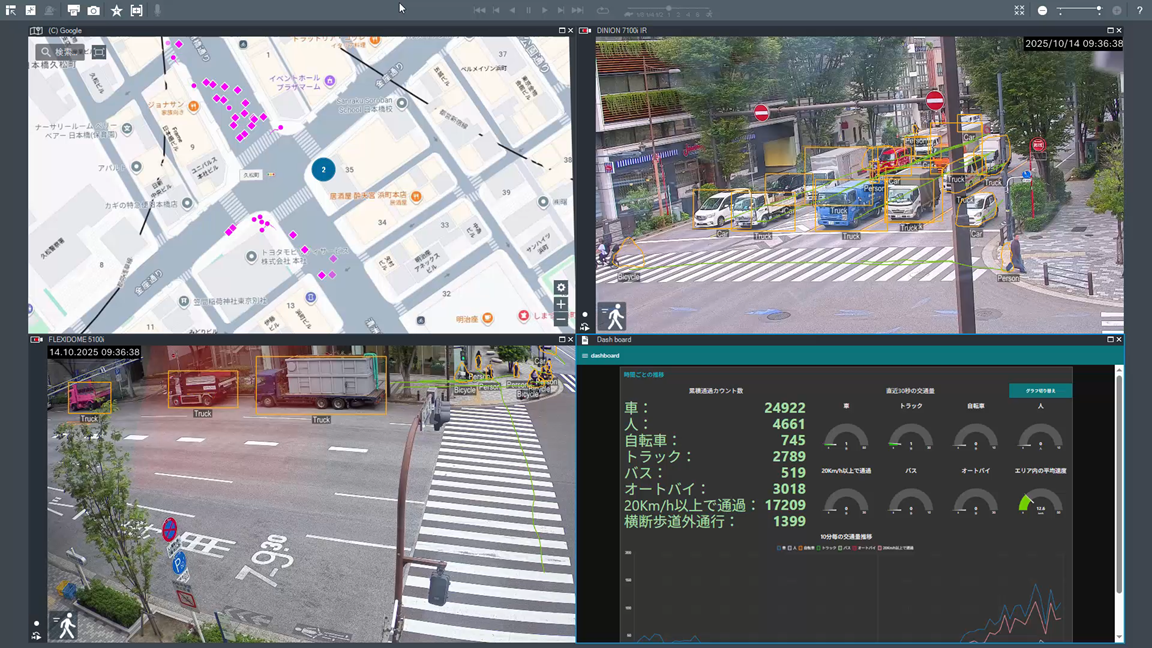
A major “already useful today” takeaway was object visualization on maps. BVMS “Global Maps” support both online GIS maps (HERE) and offline image layers (PNG/JPG), and the map-based tracking assistant is specifically tied to Global Maps.
Within that map framework, BVMS can visualize detected analytic objects on the map, which helps operators build instant situational awareness:
-
What it shows: BVMS can visualize persons and vehicles (including vehicle subclasses) as moving objects on the map.
-
What it depends on: This requires Bosch cameras capable of 3D Tracking and proper camera calibration. The System Design Guide notes that 3D Tracking mode is available with IVA Pro Perimeter, IVA Pro Traffic, and certain legacy IVA-capable platforms.
-
Why it matters operationally: In real-world terms, maps stop being a static “camera placement diagram” and become an active operational surface where personnel can see movement patterns across a site.
Object visualization on map and metadata-driven capabilities have been advancing across releases, with BVMS 13.0 described as extending object visualization further.
 Smart Forensic Search Using IVA Pro Metadata: Appearance and PPE Examples
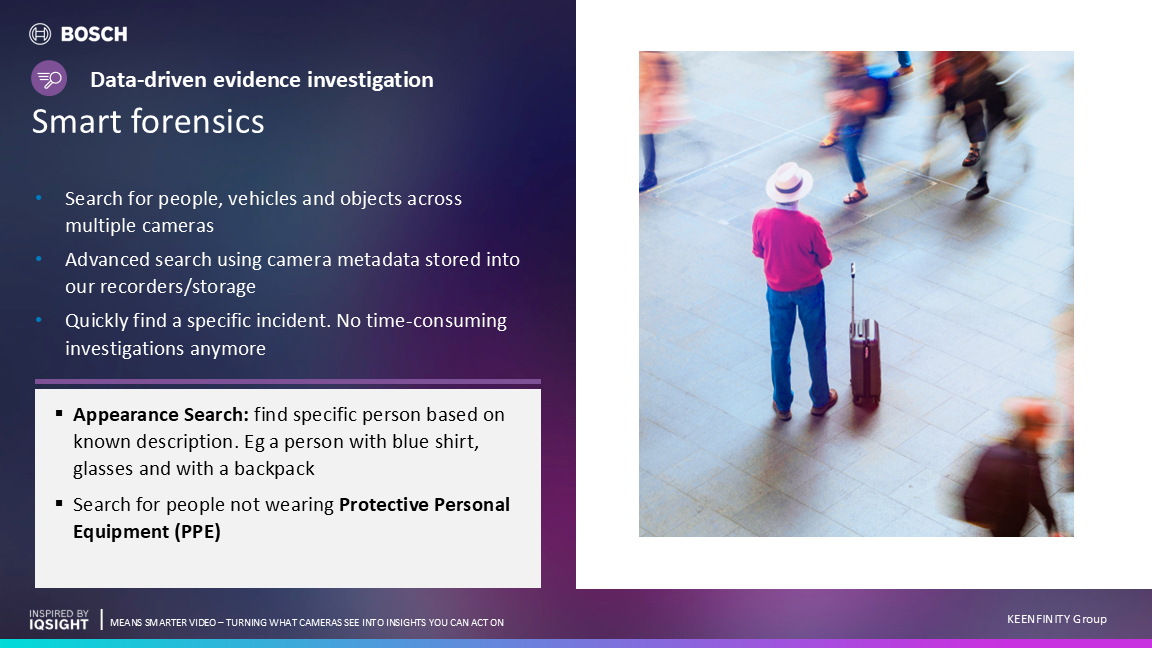
The presenters then connected mapping and visualization to a broader idea: metadata should not only help you see what is happening now, it should help you find what happened before.
They highlighted IVA Pro-driven forensic workflows such as:
-
Appearance-based search (example: searching recorded video for a subject wearing a red top and red hat, then jumping directly to matching moments on the timeline)
-
PPE detection search (example: identifying whether a person had a safety vest and hard hat in a defined environment, and using forensic results to understand when PPE was removed or absent)
This approach reinforces a key operational shift: the operator no longer needs to “scrub video” first; the operator queries metadata first, then reviews video at the highest-probability timestamps.
 BVMS “Free Text Search” in BVMS 13.1: Gen-AI Assisted Search Without Cloud Dependency
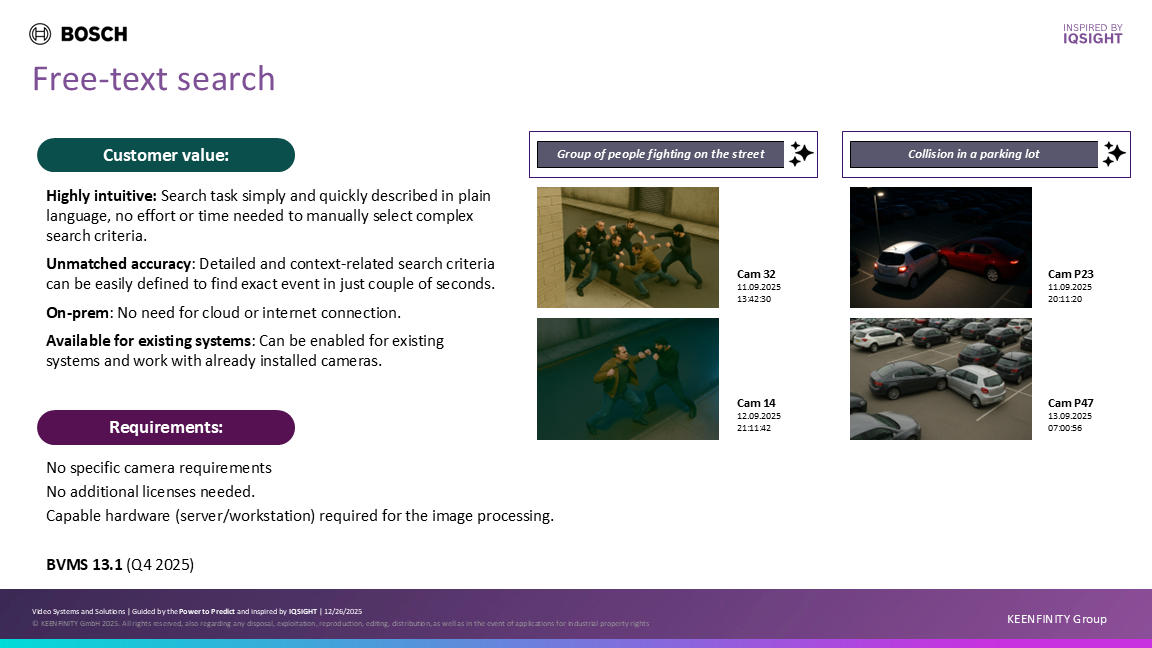
The forward-looking portion of the session previewed what they described as “free text search” (also described in the discussion as “pre-text search”), planned for BVMS 13.1.
Their stated intent was to enable an operator to type a natural-language search query that reflects context, not just object type. They gave examples like:
-
“Group of people fighting on the street”
-
“Collision in the parking lot”
The key point they emphasized is that traditional analytics can reliably identify objects (person, vehicle), but not necessarily higher-level context like fighting or collision. This feature is intended to shorten investigation time by producing “closest hits” that guide the operator quickly to relevant segments, even if it is not perfect.
Architectural concept (as presented)
They described an additional on-prem processing component that pulls video streams, generates contextual descriptors, stores that information in a database, and then answers operator searches by translating queries into matches against that stored context.
Two deployment principles they underscored:
-
On-prem by design: It is intended to run in isolated environments without internet or cloud connectivity.
-
No added BVMS license: The constraint is expected to be compute capacity rather than feature licensing, with GPU resources called out as a primary driver of performance.
They also noted a roadmap concept where the “Gen-AI component” could be updated independently of the full BVMS upgrade cycle, which is particularly relevant for large-scale systems where updating hundreds or thousands of endpoints is operationally costly.
 LPR in BVMS: From Plate Reads to Identity-Quality Decisions
They also reviewed how Bosch analytics and BVMS are evolving around LPR. Official BVMS 12.3 release information notes support for Bosch IVA Pro LPR and Make & Model, including receiving license plate and make/model information via camera events.
In the STF25 session, they framed the progression as:
-
BVMS 12.3: foundational LPR ingestion and richer vehicle attributes
-
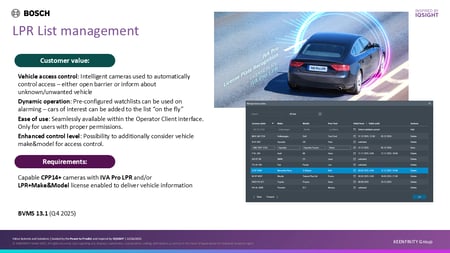
BVMS 13.1 (as previewed): adding watch list / list management capabilities so organizations can create “allow / alarm / unknown” workflows and drive responses such as gate control actions
From the analytics side, KEENFINITY documentation for IVA Pro License Plate + Make Model describes it as deep-neural-network based analytics that detects and reads plates and also recognizes vehicle make and model, enabling more discriminating workflows than plate text alone.
A particularly practical concept they highlighted is compound matching logic: requiring plate + make/model alignment before triggering an action. This is an operational response to a real threat model: plate spoofing or plate swapping.
They also discussed auditability expectations, including the ability to export license plate activity across cameras over time, consistent with using LPR as investigation-grade evidence.
 Security, Integrations, and the BVMS 14 Direction
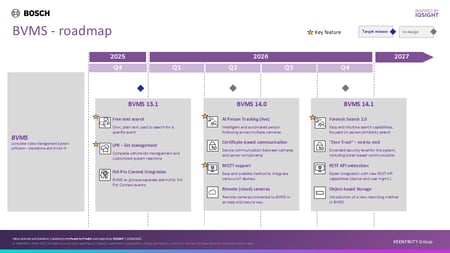
They closed by outlining a BVMS roadmap direction beyond search and LPR, including:
-
AI person tracking in live scenarios (described as the logical next step beyond map visualization)
-
Continued security hardening (certificate-based communication concepts and movement toward “zero trust end-to-end” were referenced as forward-looking priorities)
-
MQTT support to scale integration with third-party sensors and IoT devices using a standardized protocol
-
Hybrid scenarios (select cloud capabilities while keeping BVMS on-prem), including a concept of adding remote cameras via a portal and operating them in Operator Client similarly to local cameras, including live video and SD-card playback where applicable
-
Longer-term work on recording architecture to preserve BVMS strengths while enabling more flexibility such as cloud offload options
-
Expanded integration capabilities, including continued improvements toward REST API-friendly integration patterns
What to Take Back to Your Next BVMS Design Review
If you are specifying, upgrading, or re-baselining a BVMS environment for 2026 planning, the practical “next actions” implied by this session are:
-
Treat maps as an operational surface, not a drawing. Global Maps plus object visualization can materially reduce “camera hopping” time, but it requires correct camera selection, calibration, and configuration. Keenfinity Knowledge Base+1
-
Design for metadata, not just retention. The system value shifts when operators can search metadata first, then confirm with video.
-
Plan compute explicitly for Gen-AI search workflows. Even if licensing is not the constraint (as described), infrastructure sizing and GPU strategy will be.
-
Use LPR as a decision workflow, not just a read. Moving from “plate captured” to “authorized/unauthorized with corroborating make/model” is a meaningful security upgrade. Bosch Security and Safety Systems+1
-
Account for BVMS 13-era security and configuration changes during upgrades. Follow the upgrade guidance closely, including certificate validation considerations and required ports for newer operator features. Keenfinity Knowledge Base
Learn more about BVMS >>
Contact us for system design assistance >>