

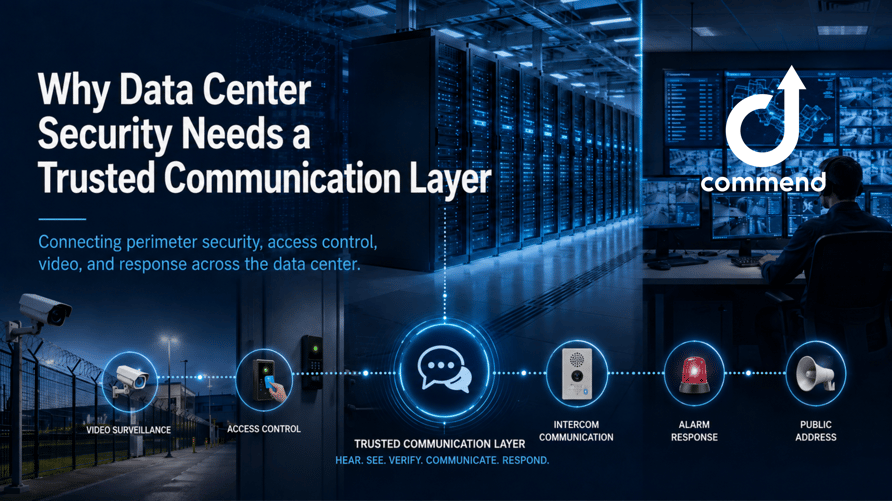
Data centers sit at the heart of almost everything organizations now depend on. Cloud computing, artificial intelligence, financial services, healthcare applications, communications, and countless business systems rely on data centers operating continuously and securely.
That makes protecting a data center much more than an IT or cybersecurity challenge. It is a critical infrastructure challenge, and many of the physical security situations that occur around a data center ultimately become communication challenges.
-
What happens when an unidentified person approaches a perimeter?
-
What should occur when a contractor is denied access to a restricted area?
-
How does a Security Operations Center verify what is happening at a remote gate?
-
And when an emergency occurs, how quickly can operators communicate with the right people and coordinate an appropriate response?
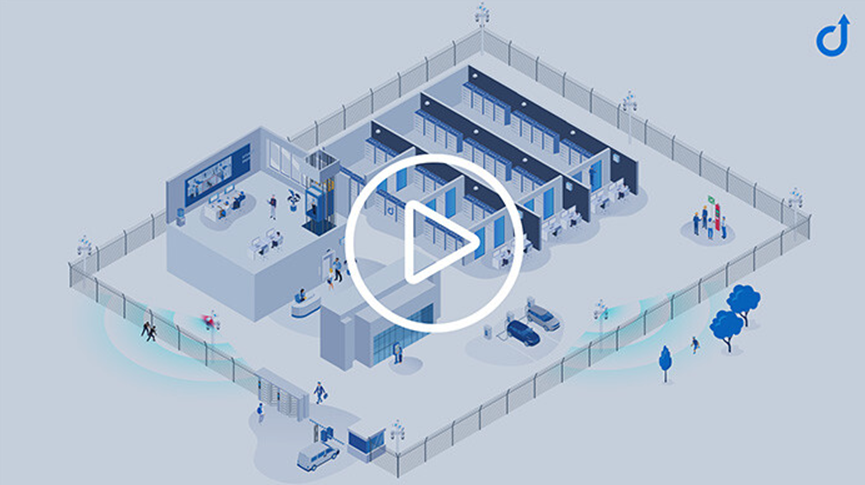
Commend approaches these challenges by providing a communication layer designed to connect people, security processes, and technology throughout the data center environment.
Data Center Security Is More Than Detecting an Event
Video surveillance, intrusion detection, access control, and analytics can tell operators that something has happened. The next challenge is determining what is actually happening and what to do about it.
Commend identifies perimeter security as the first layer of data center physical protection, with video surveillance, motion detection, security lighting, Advanced Security Intercom, and IP public address working together to discourage, detect, and delay unauthorized access. Adding real-time audio communication allows operators to interact with someone seeking access, establish their intent, and determine whether further action is necessary.
This can turn security from a primarily observational process into an interactive one.
Consider someone approaching a restricted perimeter after hours. A camera or fence sensor may detect the individual, but detection alone does not resolve the situation. An integrated communication system can initiate an automated warning, allow an operator to address the individual directly, provide instructions, and potentially de-escalate the incident before security personnel have to be dispatched.
The objective is not simply to hear or see an event. It is to hear, see, verify, communicate, and respond.
That distinction becomes particularly important in large data center campuses where perimeter fencing, employee entrances, delivery areas, loading zones, equipment areas, data halls, and other restricted spaces may all have different security requirements.
Connecting the Security Ecosystem
Modern data centers already contain numerous security and facility systems. The challenge is getting those systems to work together.
Commend communication solutions can integrate with technologies including:
- Video management systems
- Access control systems and security interlocks
- Security Operations Centers
- Fire, motion, and other detection systems
- Public address systems
- Building automation and actuators, including doors and lighting
The goal is to make communication part of the larger security workflow rather than another isolated subsystem.
Commend’s integration capabilities extend across a broad ecosystem of security technologies and platforms, including video management, access control, security management, building management, and public address. The company describes integration as the exchange of audio, video, and data that allows systems to operate in a coordinated manner rather than independently.
For a Security Operations Center, this can simplify the process of assessing an alarm. Instead of receiving an event and then moving between disconnected systems, operators can potentially combine video verification, two-way communication, access information, alarms, and response actions into a more coordinated workflow.
Turning Perimeter Detection Into Active Intervention
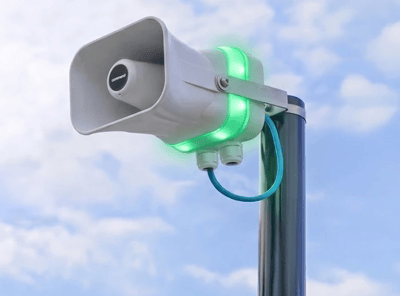 One example of this approach is the Commend AFLS-H-P IP Horn Speaker with Strobe Light.
Rather than functioning only as a traditional loudspeaker, the AFLS-H-P combines high-volume audio with a configurable LED strobe. It can be tied to cameras and sensors so that detected activity triggers an automated announcement and visual warning, or an SOC operator can address an individual directly. Commend specifically identifies critical infrastructure and data centers as applications for this type of proactive perimeter protection.
For outdoor deployment, the AFLS-H-P is IP66 and IK10 rated. It supports SIP, APIs, I/O, and ONVIF for integration with VMS, PSIM, and other security management platforms. It also incorporates a microphone with AI-assisted noise and echo suppression, Power over Ethernet connectivity, Intelligent Volume Control that adjusts output based on ambient noise, and remote system health monitoring.
This creates several possible layers of response.
A detection system can identify suspicious activity. Video can provide visual verification. The speaker can issue an automated warning. An operator can then communicate directly with the person if necessary. Lighting or other connected devices can also be activated as part of the response.
The result is a security system that can do more than document what happened. It can potentially influence what happens next.
Communication Inside the Security Operations Center
The same philosophy extends from the perimeter back to the SOC.
The SOC or control room is the center of data center security operations, where relevant information can be concentrated for faster assessment and response. Intercom stations, emergency call points, loudspeakers, alarms, and other security devices can be brought together through a common communication environment.
This becomes especially important during an emergency.
Operators may need to contact personnel throughout a facility, provide instructions through public address, coordinate with responders, communicate with someone at an emergency call point, open or secure controlled doors, and understand what is occurring through video surveillance.
Communication cannot become the weak link when multiple systems and teams must work together.
Cybersecurity Matters for Physical Security Devices, Too
Anything connected to the data center network also deserves cybersecurity scrutiny.
Commend takes a defense-in-depth approach to securing its communication products and applications. According to Commend, its company-wide information security management system is ISO 27001:2022 certified, and it was the first intercom company certified to IEC 62443. Its development teams work in accordance with IEC 62443-4-1 secure product-development processes. The company also uses secure network protocols, encrypted communications, device certificates, vulnerability monitoring, and external penetration testing as elements of its cybersecurity strategy.
Commend also reports regular internal and external penetration testing, including testing by independent experts, and publishes findings and mitigation information through its Security Advisory program. The company has additionally received a CyberVadis Gold Medal assessment for the maturity of its cybersecurity measures.
This is particularly relevant in a data center environment. Physical security devices should not introduce unnecessary vulnerabilities into the infrastructure they are intended to protect.
Reliability Matters When Communication Is Mission Critical
Integration is valuable only if the communication system is available when it is needed.
Commend supports end-to-end system monitoring designed to identify system issues and reduce downtime. Its data center architecture also supports centralized management, networking between multiple buildings or sites, integration with other systems, and communication designed to maintain intelligibility even in challenging background-noise conditions.
That reliability becomes critical during an incident. Technology can automate many security processes, but when normal operations turn into an emergency, people still need a dependable way to communicate, understand the situation, coordinate actions, and make decisions.
Designing Communication Into the Data Center Security Strategy
For integrators, consultants, and data center security teams, the key takeaway is that communication should be considered alongside video surveillance, access control, intrusion detection, perimeter protection, and SOC design, rather than added as an isolated system afterward.
-
Where should operators be able to communicate with someone remotely?
-
What happens after access is denied?
-
Can a perimeter alarm trigger both video verification and an audio warning?
-
Can security personnel speak directly to someone without dispatching an officer?
-
Can multiple sites communicate through a centralized SOC?
-
And can the system verify that communication devices are online and operational?
These questions help move a security design from simply detecting events toward understanding, verifying, communicating, and responding to them.
MidChes provides Commend system design and sales support throughout Maryland, Washington, D.C., Virginia, Delaware, Pennsylvania, and Southern New Jersey, along with pre-installation programming and additional professional services for Commend systems.
Planning a data center, critical infrastructure, or other high-security project?
Contact the MidChes team to discuss how Commend communication, intercom, public address, and integrated security solutions can fit into your overall security design.

Download Commend's Data Center Security Solutions guide >>

FAQs
How can intercom systems improve data center security?
Advanced intercom systems give security operators real-time two-way communication with people at gates, entrances, restricted areas, and emergency call points. When integrated with video, access control, and detection systems, operators can verify a situation before deciding how to respond.
Can Commend integrate with existing data center security systems?
Yes. Commend supports integration with video management, access control, security management, public address, detection, building automation, and other systems through multiple interfaces, APIs, protocols, and I/O capabilities.
What is the Commend AFLS-H-P?
The AFLS-H-P is an IP horn speaker that combines high-volume audio, two-way communication, and a configurable LED strobe. It can integrate with cameras and sensors to provide automatic or operator-controlled audio-visual warnings for perimeter and critical infrastructure applications.
Why is cybersecurity important for an IP intercom system?
IP-based intercoms and communication devices are connected network endpoints. Security measures such as encrypted communications, secure authentication, signed firmware, network segmentation, vulnerability testing, and secure development practices help reduce the risk that physical security devices introduce cybersecurity vulnerabilities.
Can Commend support multiple data center sites from one SOC?
Commend supports networking of buildings, sites, and areas for operation through centralized control environments, allowing communication to be incorporated into multi-site security operations.