
In many network deployments, especially for ITS (traffic), city roadside, or security systems, the headend or field closet becomes crowded long before the system is finished growing. Cameras, intercoms, access control devices, switches, media converters, fiber connections, and power equipment all compete for limited rack space.
That is where the AMG2036 Blade chassis becomes valuable.
In a recent discussion, Steve Pennington and Dave Sinise from AMG Systems reviewed what they commonly refer to as “the Blade.” The concept is simple: take the functionality that traditionally required larger card cages or individual media converters and place it into a compact, high-density 1U rack-mounted chassis.
For security integrators, engineers, and end users, the result is a clean way to organize multiple AMG media converter blade cards in a single rack location while saving space, simplifying maintenance, and providing flexible power options.
A Smaller Alternative to Larger Card Cage Systems
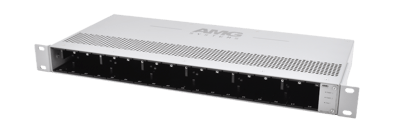 Older media conversion systems often relied on larger, 4U card cage designs. These could work well, but they consumed valuable rack space and were not always ideal for small equipment rooms, wall-mounted cabinets, or retrofit applications where space is limited.
The AMG2036 addresses that problem by supporting up to 18 individual AMG blade cards in a standard 19-inch, 1U rack chassis. Because it is not a full-depth chassis, it can fit into tighter rack environments where a deeper unit may not be practical.
This is especially useful in ITS and security applications where multiple field devices need to be brought back over fiber and connected into an existing headend solution.
Instead of mounting many individual media converters throughout the rack, the AMG2036 allows those conversion points to be grouped into a single, organized chassis.
Why Density Matters in Security System Design
Rack density is not just a convenience issue. It can directly affect project cost, serviceability, and long-term system expansion.
When a control room, equipment rack, or field cabinet has limited space, every rack unit matters. A 1U chassis that can support up to 18 blade cards allows the system designer to preserve rack space for other critical equipment such as network switches, access control panels, UPS systems, and audio equipment.
This can be particularly important in:
-
Security operations centers
-
Correctional facilities
-
Transportation and ITS environments
-
Campuses
-
Utility sites
-
Industrial facilities
-
Parking facilities
-
Distributed building security systems
-
Retrofit projects with existing fiber infrastructure
For many projects, the AMG2036 offers a practical middle ground between deploying standalone media converters and purchasing an additional optical switch.
A Practical Option When You Already Have a Headend Solution
Dave Sinise made an important point during the conversation: if a customer is building a new system from scratch, an all-optical switch may be the right answer in some designs. But many customers already have a headend network architecture in place.
In those cases, media conversion may be the more practical and cost-effective option.
If the project only requires converting multiple copper Ethernet connections to fiber, or fiber connections back to copper Ethernet, the AMG2036 can help avoid unnecessary switch purchases while still providing a clean rack-mounted solution.
This is especially useful when the goal is to extend Ethernet over fiber, repurpose existing fiber infrastructure, or consolidate multiple fiber-connected edge devices at the headend.
Flexible Power Options for Different Site Conditions
One of the strongest features of the AMG2036 is its flexible redundant power design.
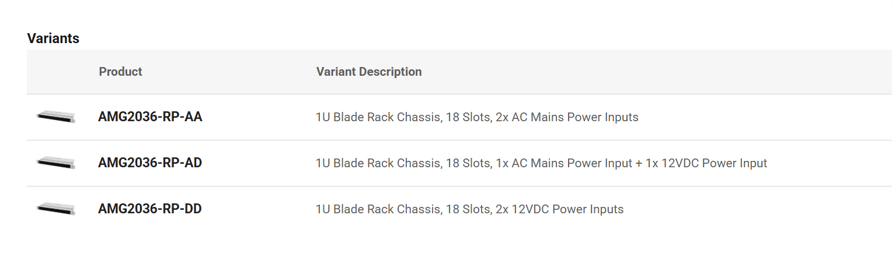
The chassis is available in multiple power configurations, including dual AC mains inputs, one AC mains input with one external DC input, or dual external DC inputs. This gives designers more flexibility when working in different site conditions.
That matters because not every equipment location is the same. Some headends may have standard AC power available. Other field closets or remote cabinets may rely on DC power. In some projects, redundancy may be required for resilience, while in others, the budget may drive a simpler configuration.
The AMG2036 gives the project team options without changing the overall chassis concept.
It also includes power supply LED indicators to support installation and fault diagnosis, along with a fault relay output for notification of power supply failure.
Hot-Swappable Blade Cards Simplify Maintenance
Another major benefit is serviceability.
The AMG2036 blade cards are fully hot-swappable. In practical terms, that means a technician can remove or replace a compatible blade card without treating the entire chassis as a fixed, difficult-to-service unit.
Steve and Dave highlighted how simple this is in the field: loosen the thumbscrew, pull the card out, insert the new card, tighten it back down, and continue.
For ITS and security systems that need to remain operational, this type of modular design is important. It allows for easier future expansion, easier troubleshooting, and faster replacement when maintenance is required.
Designed for Industrial Security Environments
The AMG2036 is not just a space-saving rack accessory. It is built for demanding industrial environments.
The chassis is rated for operation from -30°C to +75°C, uses passive cooling, and has a 0 dBA noise level. It is NDAA and TAA compliant, which is an important consideration for many government, transportation, critical infrastructure, and federally funded security projects.
The chassis is manufactured in the United Kingdom and designed in the USA and UK, with AMG Lifetime Support Warranty coverage.
Pairing the Chassis with AMG260B Blade Cards
The AMG2036 chassis is delivered empty, so compatible blade cards are selected based on the application.
This allows designers to match the blade card to the specific number of copper Ethernet devices and fiber connections needed in the system.
In the conversation, Dave also referenced remote reset and future network management capabilities associated with AMG’s newer media converter platform. For project specifications, integrators and engineers should confirm the current availability of those management features for the exact blade cards and chassis configuration being used.
Where the AMG2036 Fits Best
The AMG2036 is a strong fit when a project requires multiple media conversion points in a compact rack space.
Common use cases include:
-
Bringing multiple fiber-connected cameras back to a control room
-
Connecting remote field devices into an existing headend network
-
Supporting retrofit projects where existing fiber is being reused
-
Reducing the number of standalone media converters in a rack
-
Organizing media conversion in a clean, serviceable chassis
-
Supporting projects where redundant AC or DC power options are required
-
Providing a compact solution for small wall-mounted 19-inch rack enclosures
For security integrators, the value is straightforward: less rack clutter, easier maintenance, flexible power, and a dense chassis that can support many field connections in a small amount of space.
A Simple, Dense, Serviceable Approach to Media Conversion
The AMG2036 Blade chassis is not trying to replace every switch or every network design. Instead, it solves a very specific and common problem in security system deployments: how to manage multiple media converters cleanly, efficiently, and reliably inside a rack.
For systems where fiber is being used to extend Ethernet, connect remote devices, or support existing infrastructure, the AMG2036 gives engineers and installers a compact 1U platform that can grow with the system.
It is dense, modular, hot-swappable, and flexible enough to support different power environments.
For many security projects, that combination can make the difference between a crowded rack full of individual devices and a cleaner, more professional headend design.
Contact us for system design >>

Data sheet >>

FAQs
What is the AMG2036 blade chassis?
The AMG2036 is a 1U, 19-inch rack-mounted blade chassis from AMG Systems. It supports up to 18 AMG Blade devices and is designed to provide high-density mounting for industrial media converters in security, transportation, industrial, and other networked infrastructure applications.
Why would a security system use the AMG2036?
An ITS or security system may use the AMG2036 when multiple field devices need fiber-to-copper or copper-to-fiber media conversion at the headend. It helps reduce rack clutter, saves space, supports hot-swappable blade cards, and provides flexible redundant AC or DC power options.
Is the AMG2036 useful for retrofit projects?
Yes. The AMG2036 is especially useful in retrofit projects where existing fiber infrastructure is being reused and the customer already has a headend network solution. Instead of adding standalone media converters or another optical switch, compatible AMG Blade cards can be installed in the chassis to support organized media conversion.
How many blade cards does the AMG2036 support?
The AMG2036 supports up to 18 individual Blade cards, depending on the width of the selected cards. Single-slot cards allow the chassis to reach the full 18-card capacity.
Are AMG2036 blade cards hot-swappable?
Yes. The AMG2036 supports fully hot-swappable blade cards, which helps simplify future expansion, troubleshooting, and maintenance.
What problem does the AMG2036 solve?
The AMG2036 solves the problem of managing multiple media converters in limited rack space. It consolidates compatible AMG Blade cards into a compact 1U chassis, helping reduce clutter and improve serviceability.
When should I use a media converter chassis instead of an optical switch?
A media converter chassis can be a better fit when the customer already has a headend network solution and only needs to convert copper Ethernet to fiber, or fiber back to copper. An optical switch may make sense for some new deployments, but media conversion can be more cost-effective in many retrofit or targeted expansion projects.
What power options are available for the AMG2036?
The AMG2036 is available with different redundant power configurations, including dual AC mains inputs, one AC mains input with one external DC input, or dual external DC inputs.
Is the AMG2036 suitable for harsh environments?
Yes. The chassis is rated for operation from -30°C to +75°C, which makes it suitable for many demanding industrial and security environments.
Is the AMG2036 NDAA and TAA compliant?
Yes. The AMG2036 chassis is NDAA and TAA compliant.
Does the AMG2036 include Blade cards?
No. The AMG2036 Blade chassis is delivered empty. AMG Blade cards and blanking panels are sold separately.